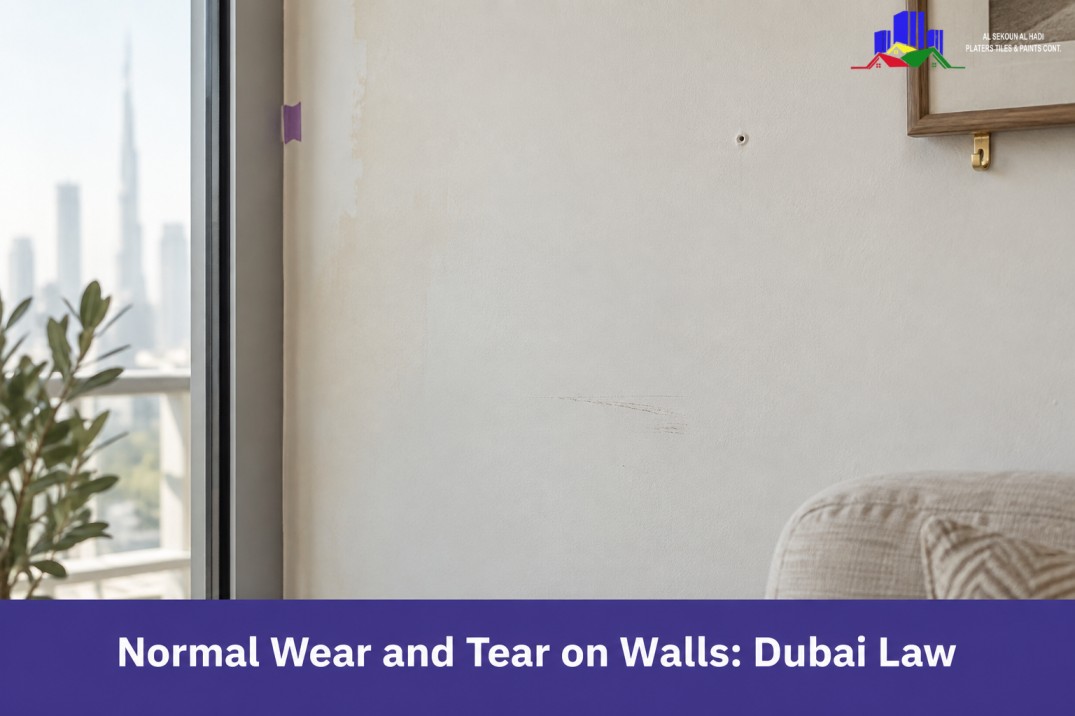
You’re doing your final walkthrough before handing back the keys, and suddenly you’re staring at every little mark on the wall like it’s evidence in a trial. That faded patch near the window. The tiny holes where your framed photos used to hang. A scuff by the sofa.
Is any of that going to cost you part of your deposit? It’s one of the most common worries tenants have in Dubai, and honestly, it’s a fair one, because plenty of landlords will try their luck if you don’t know where the line actually is. Let’s settle it clearly.
What Counts as Normal Wear and Tear on Walls in Dubai? (Quick Answer)
Normal wear and tear is the gradual, unavoidable deterioration that happens to walls simply from everyday living. For Example, faded or yellowed paint from sunlight and age, light scuffs from furniture, and small nail or picture-hook holes. Under Dubai tenancy law, this kind of ordinary ageing cannot be charged to the tenant or deducted from the security deposit. It’s the price of time passing in a lived-in home, and it’s the landlord’s responsibility, not yours. If you want the fuller picture of your move-out obligations beyond just the walls, our move-out painting guide for Dubai tenants covers the rest of the process.
Normal Wear and Tear vs. Tenant Damage:
Almost every dispute over walls comes down to one simple question, and it’s the same question Dubai’s rental authorities effectively apply when they’re asked to decide: would this damage have happened regardless of who was living there, just from normal use of the property? If the answer is yes, it’s wear and tear, and it’s the landlord’s cost. If the answer is no, meaning the damage only happened because of something this specific tenant did, it’s tenant damage, and it’s chargeable.
The One-Question Test Behind Most Dubai Wall Disputes
It sounds almost too simple, but it holds up surprisingly well in practice. A wall fading over three years of sunlight would fade for any tenant. A wall with a fist-sized hole punched through the drywall would not happen to just anyone. That contrast is really the whole test.
What Dubai Tenancy Law Actually Says
Renting in Dubai is governed by Law No. 26 of 2007 (Regulating the Relationship Between Landlords and Tenants in the Emirate of Dubai), and a handful of its articles are what every wear-and-tear argument ultimately traces back to.
Article 21: Returning the Property in Its Original Condition
Article 21 requires the tenant to hand the property back in the same condition it was received in, with one important carve-out: except for ordinary wear and tear, or damage caused by reasons outside the tenant’s control. That exception is doing a lot of work. It’s the legal basis for why a landlord cannot simply point at any mark on a wall and demand payment.
Articles 16 and 17: The Landlord’s Maintenance Duty
These articles place responsibility on the landlord for defects, damage, and wear and tear that aren’t the tenant’s fault, keeping the property fit for its intended use throughout the lease. Unless the contract says otherwise, this is the default landlords are held to.
Articles 19, 22 and 23: What Tenants Are Responsible For
Tenants are expected not to make unauthorised alterations, to pay any taxes or fees tied to their use of the property, and to remove anything they added or changed before handover. This is exactly why an accent wall painted without written approval, or shelving drilled into a wall without permission, tends to fall on the tenant’s side of the ledger.
Wall Damage That is Normal Wear and Tear (Landlord Pays)
- Paint that has faded or yellowed with age and sunlight
- Small nail or picture-hook holes from hanging photos or shelves
- Minor scuffs and light marks from furniture or everyday foot traffic
- Hairline cracks from the building naturally settling over time
- Light UV fading near windows where sunlight hits the wall daily
If a landlord is trying to charge you for anything on this list, they’re on shaky legal ground, and it’s worth knowing this is the same principle that decides who pays for painting when you move out in Dubai in the first place, since routine repainting between tenancies almost always falls into this same “ordinary ageing” category.
Wall Damage That Is NOT Wear and Tear (Tenant Pays)
- Large holes, drilled anchor points, or clusters of holes from mounting shelves and TVs
- Walls painted a different colour without the landlord’s written approval
- Deep or permanent stains, including crayon, marker, or grease
- Water damage or mould caused by a leak the tenant never reported
- Gouges, dents, or cracked plaster from moving furniture carelessly
If your landlord is pointing at something from this list, that’s a legitimate deduction, and it’s worth just accepting it rather than fighting a battle you’re unlikely to win.
The Grey Areas: Nail Holes, Scuffs, Fading and Cracks Explained
This is where most real-world disagreements actually happen, because not every mark fits neatly into either list above.
Can a Landlord Deduct Your Deposit for Nail Holes?
A few small holes from picture hooks or a shelf bracket are considered normal, especially after a tenancy of a year or more. Where it tips into damage is volume and size: a dozen drilled holes clustered together, or large anchor holes from mounting a heavy mirror or TV bracket, go beyond what “hanging a few photos” would reasonably cause.
Is Faded Paint Normal Wear and Tear in Dubai?
Yes. Paint naturally fades and yellows with age and sun exposure, and Dubai’s climate accelerates this. A landlord cannot charge you for paint simply looking tired after a year or two of normal living; that’s ageing, not damage.
Scuffs and Marks vs. Gouges and Stains
A scuff from a chair being pushed back or a bag brushing the wall is everyday wear. A gouge that’s cut into the plaster, or a stain that’s soaked in and won’t wipe or repaint over cleanly, has crossed into damage territory. If chips or gouges have already happened, it’s worth knowing how chipped paint gets repaired properly before a landlord quotes you for a full repaint over a small patch job.
Cracks: Settlement vs. Impact Damage
Fine, hairline cracks that appear as a building settles over time are structural and not the tenant’s doing. A crack caused by something being thrown, dropped, or forced against the wall is a different story entirely.
How Much Wear and Tear Is “Allowed”? The Role of Tenancy Length
There’s no fixed percentage or official allowance written into the law, and anyone telling you there’s a hard number is guessing. What actually matters in practice is how long you lived there. A tenant who stayed five years has walls that should reasonably show more fading, more small marks, and more general softening of paint than someone who moved out after eight months. Landlords, and any dispute authority reviewing the case, tend to weigh the length of the tenancy heavily when deciding what’s reasonable.
Who Pays to Repaint the Walls at Move-Out?
This is the question that actually costs someone money, so it’s worth getting precisely right. The position taken by Dubai’s Rental Disputes Centre has been that cleaning and repainting the interior walls after a tenant moves out is the landlord’s responsibility, not the tenant’s, as a matter of ordinary upkeep between tenancies.
You’ll see this repeated across a lot of blogs as a “RERA regulation,” but that’s not accurate. It comes from the Rental Disputes Centre’s own position rather than a specific RERA rule, and it can be overridden entirely if your tenancy contract contains a clause explicitly requiring the tenant to repaint before handover. So the real answer is: check your contract first, because a written clause always beats the general default.
If you do end up needing to arrange the repaint yourself, whether because your contract requires it or because you’d rather control the quality and cost than let a landlord deduct for a marked-up job, it’s usually far cheaper and less stressful to book it yourself.
It’s worth weighing up DIY versus professional painting on cost, time and quality before deciding, since a poorly matched touch-up can end up costing more to fix than it saved.
Al Sekoun’s move-out painting services in Dubai are built around exactly this handover scenario, with landlord-approved finishes designed to pass inspection the first time, and our piece on why move-out painting services matter for tenants and landlords goes into more detail on how a proper repaint protects your deposit.
If it’s the walls specifically that need attention rather than a full unit repaint, our wall painting services in Dubai page covers that scope on its own.
What Your Landlord Can Legally Withhold
A security deposit exists to cover a specific, limited set of things, not to act as a general-purpose fund the landlord can dip into. The same wear-and-tear principles apply whether you’re renting an apartment or a villa, though the surface area and inspection scope naturally differ between the two, which is why we run separate apartment painting services and villa painting services pages. Legitimate deductions generally include:
| What Can Be Deducted | What Cannot Be Deducted |
| Damage beyond normal wear and tear | Faded or aged paint |
| Unpaid rent | Minor nail holes or scuffs |
| Outstanding DEWA or utility bills | Worn carpet from normal foot traffic |
| Missing furnished items (furnished units) | General “tiredness” of the property |
| Professional cleaning if left excessively dirty | Routine end-of-tenancy repainting |
There’s no fixed legal cap on the deposit amount itself, though 5% of annual rent for unfurnished units and 10% for furnished units is the widely followed market norm. Any deduction should come with an itemised explanation and, ideally, supporting invoices or photos, and it helps to know what a fair repaint invoice actually looks like before you accept one, which our Dubai painting cost guide breaks down by property size.
A landlord who withholds money with no documentation at all is on weak footing if the matter ever goes to a dispute hearing.
Protect Your Deposit
If there’s one habit that prevents almost every wall dispute before it starts, it’s this: document everything. Walk through the unit on move-in day and take timestamped photos or video of every wall, room by room, before you unpack a single box.
Do the same again just before you hand back the keys. If your landlord or agent offers a formal check-in or check-out inspection report, sign it, but don’t rely on it alone. Your own photos are the evidence that actually protects you if a disagreement comes up months or years later.
What to Do If Your Landlord Charges You Unfairly for Wall Damage
- Put it in writing first. Send a message or email referencing your lease and clearly explaining why you believe the deduction is unfair. This creates a paper trail and often resolves things on its own.
- Attach your evidence. Your move-in photos are your strongest asset here.
- Escalate if you have to. If the landlord won’t budge, you can file a case with the Rental Disputes Centre at the Dubai Land Department. Your Ejari registration is required for this, so make sure your tenancy was properly registered.
- Know it’s usually a last resort. Most disputes never need to go this far once clear evidence is on the table, but it’s reassuring to know the option exists if a landlord refuses to be reasonable.
Frequently Asked Questions
1. What counts as normal wear and tear in a Dubai apartment? Gradual fading of paint, minor scuffs from furniture, and small nail holes from hanging photos are all considered normal wear and tear, and a landlord cannot deduct these from your deposit.
2. Can my landlord charge me for repainting when I move out? Generally no, since repainting between tenancies is treated as ordinary upkeep and falls on the landlord, unless your specific tenancy contract includes a clause requiring the tenant to repaint before handover.
3. Can a landlord deduct my deposit for nail holes? A few small holes from picture hooks are normal wear and tear. A large cluster of drilled holes or heavy anchor points used for mounting shelves or a TV can be treated as tenant damage.
4. Is faded paint considered damage in Dubai? No. Paint naturally fades and yellows over time from sunlight and age, and this is considered normal wear and tear, not damage caused by the tenant.
5. How much can a landlord deduct for wall damage? There’s no fixed figure. Deductions should be proportional to the actual cost of repair and supported by an itemised invoice or receipt, not an arbitrary amount.
6. Do I have to repaint the walls before moving out in Dubai? Only if your tenancy contract specifically says so. Without that clause, routine repainting is the landlord’s responsibility as part of preparing the unit for the next tenant.
7. What is the difference between wear and tear and damage under UAE tenancy law? Wear and tear is deterioration that would happen regardless of who lived in the property, like fading paint or light scuffs. Damage is harm caused specifically by the tenant’s actions or negligence, like large holes or unreported water leaks.
8. How long does a landlord have to return my deposit in Dubai? There’s no strict legal deadline written into the law, though returning it promptly after move-out, commonly cited as around 30 days, is standard practice and expected in good faith.
Final Thoughts
Most wall disputes in Dubai come down to a simple mismatch between what a landlord hopes they can charge for and what the law actually allows. Once you know the difference between ordinary ageing and genuine damage, and you’ve got timestamped photos to back yourself up, there’s very little a landlord can push past you unfairly. And if repainting does end up on your plate, a proper, professional finish is a small cost compared to the alternative of losing part of your deposit over a job done badly.
Note: This article is for general information only and does not constitute legal advice. For a dispute involving your specific tenancy contract, consult a licensed legal professional or the Rental Disputes Centre.